

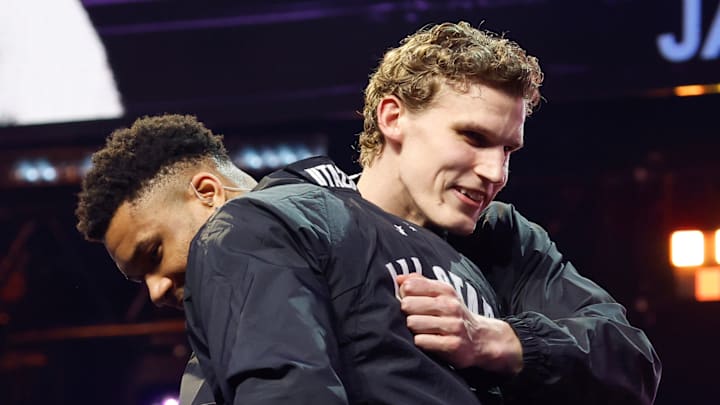
The Milwaukee Bucks' current position is among the worst in the NBA. They have one of the best NBA players, but are struggling just to make the play-in, and they're sorely limited in how to get better from here. The Utah Jazz could have helped them with that before it got out of hand, but a potential trade would have hurt Utah's cap room, as they would have demanded the last of Milwaukee's draft capital.
Giannis expressed his frustration with the Bucks' current situation, and it's hard not to see where he's coming from, given the team's 18-25 record.
"We're not playing hard. We're not playing to win. We're not playing together. Our chemistry's not there. Guys are being selfish…Guys trying to do it on their own.”
— Hoop Central (@TheHoopCentral) January 22, 2026
— Giannis
(h/t @ohnohedidnt24)
pic.twitter.com/qT3BSQns4S
It's tough to say the Jazz would have saved the Bucks from this situation last summer, but they could have at least given them more long-term hope. How so? By agreeing to swap the expiring contracts of John Collins, Collin Sexton, and Jordan Clarkson for the injured Damian Lillard.
In Milwaukee's defense from all of what's happened to them, they had to do something about Lillard because they couldn't afford to pay him while he recovered from the sidelines. Especially when it was undebatable that the Dame trade was a failure in Milwaukee, but they were also limited on options.
Clearly, they thought the best option was to waive and stretch Dame to sign Myles Turner. A good player, but is not, never has been, and never will be a star. Is Turner better than the aforementioned ex-Jazz veterans above?... Sure? But is he that much better to justify paying Lillard dead money over the next few years to get him? Absolutely not.
Lillard was owed a little over $54 million before he was stretched, meaning Collins ($26.4 million), Sexton ($18.9 million), and Clarkson ($14.2 million) would have been enough to cover expenses. Sure, the Bucks would have probably had to throw in some cap filler to make the salaries work, but this was feasible. We must remember that Utah's motivation was simply to get rid of those three without giving up assets, so this was a doable deal.
The Jazz could have given the Bucks more depth for Lillard, which in turn could have made their current standing better while also giving them the cap room to chase someone else (maybe even better than Turner) in 2026, while not having pay tens of millions in dead money like they currently are with Lillard.
But the Jazz would not have made it easy on the Bucks
Utah could have done a big favor for Milwaukee. However, with Lillard having two years and being out for the season, it would come at a cost. The Bucks have two assets: their 2031 and 2032 first-round picks. The Jazz couldn't feasibly have demanded both of them, but they could have asked for one unprotected and the other to be a pick swap.
That may sound unreasonable, but acquiring Lillard would have come at the cost of the cap room they are currently preparing to have this summer. Doing the Bucks a favor would have made it reasonable for Utah to demand that kind of compensation, but it's a risk Utah would have been willing to take.
That may have been why this scenario could have been hypothetically discussed between the two sides, but never went anywhere because neither side was willing to compromise that much. Regardless, the Jazz are in a promising long-term position, while the Bucks are pretty much the opposite.
This Jazz season as a whole hasn't gone much better than last year's travesty, but there is a lot more excitement about them now compared to the start of the year. And even if things haven't been great, the Jazz can take pride in knowing their long-term outlook is better than teams like the Bucks. Hypotheticals like these, in light of all that's transpired, are proof of that.
 Add us as a preferred source on Google