

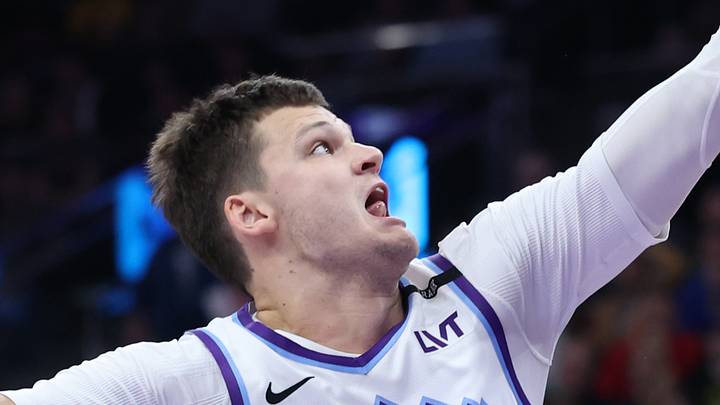
NBA teams are facing difficult times in retaining their depth, and the second apron is one thing that is being blamed for this. The Utah Jazz know this well, as their decision to trade Walker Kessler over the summer is Exhibit A for small market teams trying to avoid getting into salary cap purgatory.
Kessler was in the perfect situation in the summer of 2026 - he hadn't played much the prior season due to an injury (and Utah's tanking); there was a serious shortage of big men on the market, and he had a team with serious interest (the Los Angeles Lakers).
Not to mention that the Jazz already had two max players (Jaren Jackson Jr. and Lauri Markkanen), with Keyonte George on deck for a big-money rookie extension as well.
Kessler was miffed that he didn't get extended a year earlier, and so was destined to test the market. But without the second apron, the Jazz would have likely offered him what he wanted without question.
All of that was thanks to the punishing restrictions the NBA applies to teams going into the 2nd apron - $221.68 million for the 2026-27 season.
Since we don't live in that world, and the $221.68 second apron loomed large, the Jazz had to face the facts that signing Kessler to the same deal the Lakers offered would have put them at the doorstep of huge financial penalties in the future.
Making the best of the situation and creating a sign-and-trade was great by the Jazz in the long run, but it shouldn't have to be that way.
The second apron is limiting NBA teams from building the best rosters
With teams all over the association forcing rotation players into below-market-value deals, the NBA's middle class is being systematically eliminated. Even on the Jazz - players like Josh Okogie, Jusuf Nurkic, and Jaxson Hayes all took less this offseason - and Cody Williams was moved in a deal for salary reasons. Kevin Love remains unsigned, and he should be on a roster somewhere.
And yet the NBA continues to stubbornly claim that players everywhere are making more money under the current CBA, and everything's fine:
Recent reports asserted that the second apron is hurting “lower” and “middle” class players. That’s untrue. Since the implementation of the second apron, the number of players on team rosters has remained the same and annual salaries have increased by nearly $1.3 billion…
— NBA Communications (@NBAPR) October 9, 2026
Meanwhile, over half of the players who signed non-rookie contracts during 2026 free agency were on deals that had only a single season guaranteed. And for the Utah Jazz, it's likely to get worse in coming years, as they won't be able to keep every young player.
Ace Bailey, Darryn Peterson, Brice Sensabaugh, Isaiah Collier wlll all need new deals eventually, and someone will have to go to that the Jazz would rather keep. Who will that be? Nobody knows, but it won't be a good day when the Jazz have to face the music and let a talented young player go because they're hard-capped at the second apron.
Walker Kessler was the first casualty for the Jazz in this game of economics and cap restrictions. But he likely won't be the last. And that's ridiculous for teams to be unable to retain their own players due to a system that was designed to prevent superteams.
 Add us as a preferred source on Google