

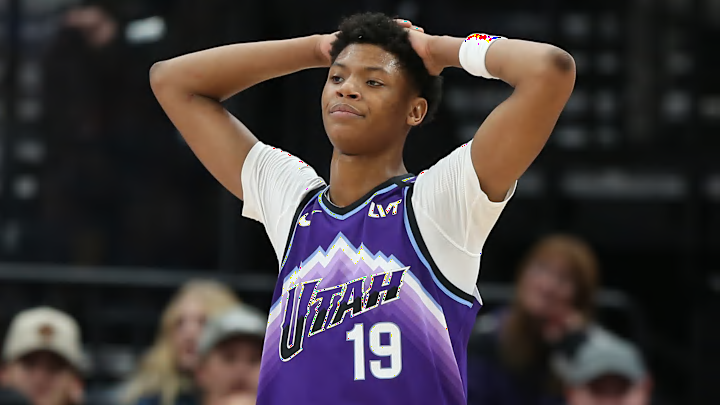
In the last two NBA Drafts, the Utah Jazz have taken Ace Bailey and Cody Williams with the 5th and 10th overall picks respectively. Looking back, the front office could have had Tre Johnson instead of Bailey and Jared McCain instead of Williams. Is it possible the Jazz drafted the wrong guard twice?
Of course, it's still very early in Bailey's NBA career. He has a promising future ahead of him, and it's far too early to say Johnson will be definitively better than him. With that being said, the Washington Wizards rookie has shown plenty of shooting touch while shooting efficiently, and he looks like he has a long career in this league ahead of him as well.
Then when it comes to Williams, he was drafted as a long-term upside swing with a lengthy developmental runway. The problem is that Utah is still searching for answers in its guard rotation, and McCain has already provided that clarity for Philadelphia. His shooting gravity and off-ball movement have translated immediately, which are traits the Jazz could desperately use in a backcourt that often struggles to create easy offense.
The Jazz might have missed two big draft opportunities
Utah’s offense has lacked rhythm for stretches this season, particularly in the half court. Too many possessions devolve into late-clock creation or contested jumpers, and reliable perimeter shooting remains inconsistent. That's where a player like McCain would help a bunch. He doesn't need the ball in his hands to be impactful. Simply having him on the hardwood changes the defensive spacing. Those are plug-and-play skills that teams crave when they're still trying to find their identity.
Bailey’s situation is a bit more nuanced. His physical tools and scoring upside are evident, but the efficiency has been up and down, and his role has fluctuated. Utah has asked him to do a lot early, sometimes without the infrastructure to support it. Johnson, meanwhile, has thrived in a simplified role that emphasizes his shooting and decision-making. The contrast highlights how readiness can matter just as much as ceiling.
None of this means the Jazz should panic or regret their direction outright. Development was always part of the plan, and both Bailey and Williams still have time to grow into impactful players. But these early returns do raise valid questions about their process. Utah passed on guards with clear NBA-ready skills in favor of longer bets, and the margin for error on those decisions is slim.
For a franchise in the middle of a rebuild, draft hits are everything. The Jazz are in need of foundational pieces. As Johnson and McCain continue to produce, Utah will be forced to reckon with whether patience was the right call, or whether they simply overthought two opportunities that were sitting right in front of them.
 Add us as a preferred source on Google